
On December 8 local time, a side event themed “Promote new-type electrification centered on clean energy, seek sustainable energy solutions for a resilient planet” was held in Nairobi, Kenya, during the Seventh Session of the United Nations Environment Assembly (UNEA-7). The event was hosted by GEIDCO and co-organized by the United Nations Environment Programme (UNEP), Kenya’s Ministry of Energy and Petroleum, and the World Wide Fund for Nature (WWF). It brought together over 100 participants from more than 50 institutions worldwide, including representatives of UN agencies, governments, and international organizations.
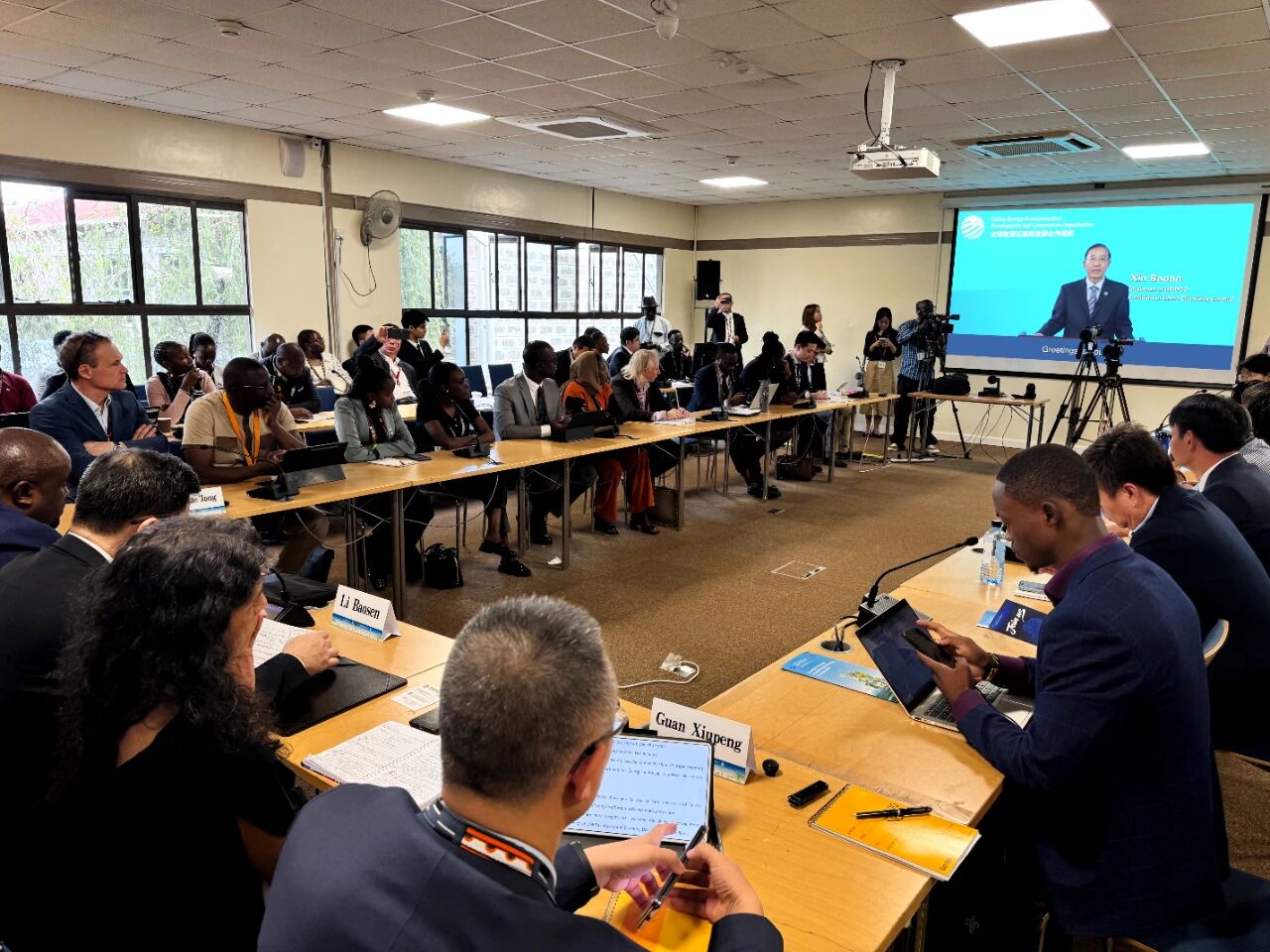
Mr. Xin Baoan, Chairman of GEIDCO and President of the China Electricity Council (CEC), delivered opening remarks. Also attending and delivering keynote speeches were H.E. Alex Kamau Wachira, Permanent Secretary of Kenya’s Ministry of Energy and Petroleum; Ms. Sheila Aggarwal-Khan, Director of the Industry and Economy Division at UNEP; Mr. Wang Wenan, Director General of the Africa Office of State Grid Corporation of China (SGCC); Mr. Thomas Opande, Africa Energy Lead at WWF-International; and Mr. Li Baosen, Deputy Secretary General of GEIDCO.
Mr. Xin Baoan noted that energy forms the material foundation for economic and social development. Since the Industrial Revolution, the large-scale exploitation and utilization of fossil fuels, such as coal, oil, and natural gas, have greatly propelled productivity, while simultaneously giving rise to global challenges, including climate change, environmental pollution, and biodiversity loss. GEI is a modern energy system that is clean-energy dominant and electricity-centric, featuring extensive interconnection, intelligence, and efficiency. It provides a key platform for the large-scale development, transmission and utilization of clean energy, facilitating the transition toward cleaner energy production, electrified energy consumption, wide-area energy allocation, and digitalized and intelligent energy ecosystems. GEI offers a holistic, balanced, effective and implementable action plan for coordinated governance of energy, climate, and environmental challenges.
Mr. Xin stressed the need to accelerate progress toward emission-reduction targets. He called for scaling up the development of new energy sources such as solar, wind, and hydropower, ensuring the safe, reliable, and orderly replacement of fossil fuels.
He highlighted the importance of strengthening global environmental governance and speeding up the establishment of a green and low-carbon system for energy production and consumption to reduce fossil fuel use at its source. He also called for deepening cooperation on green energy and leveraging the strengths of the GEI platform to provide systematic solutions that support countries in fulfilling their emission-reduction commitments and protecting ecosystems.
H.E. Alex Kamau Wachira stated that advancing new electrification is a long-term strategic pillar for Kenya and Africa in building a secure, modern, and sustainable energy system. This includes large-scale renewable energy supported by digital grids, clean electricity-powered transportation systems, and regional power trading that delivers both stability and lower costs. He expressed the hope to deepen cooperation with partners such as GEIDCO to jointly build a clean, resilient, equitable, digital, and inclusive energy future.
Ms. Sheila Aggarwal-Khan noted that UNEP is accelerating the rollout of electric mobility programs, supporting more than 60 countries in developing policies and regulations for transport electrification, and unlocking significant investment opportunities in charging infrastructure. At the same time, she emphasized that the critical minerals required for new electrification are essential for nature and biodiversity, highlighting the need to strengthen their sustainable use.
Mr. Wang Wen’an highlighted that renewable energy now accounts for 60% of China’s total installed capacity, with wind and solar contributing nearly half. Through ultra-high voltage (UHV) transmission, clean electricity generated in the Northwest is delivered to major load centers in the East. He affirmed that SGCC is ready to enhance cooperation with African countries in renewable energy development, grid interconnection, and electric mobility technologies.
Mr. Thomas Opande emphasized that 75% of global greenhouse gas emissions come from energy systems. WWF is committed to driving a system-wide phase-out of fossil fuels and promoting "nature-positive" renewable energy solutions. He stressed that the energy transition must be “greener, fairer, and faster,” and that financial instruments such as low-interest loans can help improve end-user access to clean energy.
During the event, senior representatives from Senegal and Sierra Leone, together with experts from GEIDCO members including State Grid Zhejiang Electric Power, China Southern Power Grid International, and Far East Wisdom Energy, shared perspectives on electrification development, clean and low-carbon pathways, and typical cases of electric vehicle charging and battery-swap services. They underscored that advancing the energy transition and sustainable development requires strengthened regional and global cooperation. Participants agreed that the transition must follow people-centered, just, inclusive, and locally driven principles, ensuring that new energy systems are safer, more convenient, and more accessible—especially for women and marginalized groups.
As the world’s highest-level decision-making body on environmental matters, the United Nations Environment Assembly (UNEA) brings together all 193 UN member states every two years. It is responsible for shaping the global environmental agenda, providing overarching policy guidance, and formulating responses to emerging environmental challenges. This year’s Assembly addressed issues ranging from wildfire management to the environmental impacts of artificial intelligence, with one of the core agenda items being the review and adoption of the Medium-Term Strategy 2026–2029.
As an accredited observer of UNEA, GEIDCO highlighted in its 2023 flagship report, Global Energy Inclusive, Just and Resilient Transition — Solutions and Practices, a forward-looking and systematic approach to addressing the challenges of energy transition through the “Three Synergies.” These include promoting an inclusive, just, and resilient transition by fostering synergies between clean and fossil energy, energy and industry, and energy and meteorology, with the aim of building a modern energy system that is secure, efficient, smart, green, and open. As the global energy transition enters deeper and more complex stages—where concerns over security and equity are becoming increasingly prominent—the Global Energy Interconnection (GEI) initiative is set to play a greater international role, moving from conceptual and theoretical frameworks toward deeper, more practical contributions to global governance.
As the first international energy organization registered in China, since its establishment, GEIDCO has frequently participated in UNEA, UN Climate Change Conferences, and Biodiversity Conferences. It has organized thematic events, released research findings, and contributed solutions, actively supporting global energy, climate, and environmental governance. Currently, it has obtained consultative status with UNEP and UNIDO, and observer status with the UNFCCC Secretariat and Biodiversity Conference, becoming an internationally influential organization.
As the first international energy organization registered in China, GEIDCO has actively participated in the United Nations Environment Assembly, the UN Climate Change Conferences, and the Conferences of the Parties to the Convention on Biological Diversity (CBD) since its establishment. It has organized thematic events, released research findings, and contributed practical solutions, playing an active role in advancing coordinated global governance on energy, climate, and the environment. GEIDCO has obtained consultative status with UNEP and UNIDO, as well as observer status with the UNFCCC Secretariat and the Convention on Biological Diversity, becoming an international organization with growing global influence.
During the UNEA, the GEIDCO delegation led by Deputy Secretary General Mr. Li Baosen held discussions with H.E. Alex Kamau Wachira, Permanent Secretary of Kenya’s Ministry of Energy and Petroleum; Ms. Sheila Aggarwal-Khan, Director of UNEP’s Industry and Economy Division; Mr. Xia Huang, the UN Secretary-General’s Special Envoy for the Great Lakes Region; and Mr. James Karari Wahogo, Secretary-General of the Eastern Africa Power Pool. The meetings featured in-depth exchanges on renewable energy development in Africa, cross-border grid interconnection, and transport electrification, resulting in a series of cooperation consensus.
GEIDCO also organized a “Member Event,” attended by representatives from State Grid Corporation of China, China Southern Power Grid, Energy China, PowerChina, LONGi Green Energy, Far East Wisdom Energy, and TBEA. These members took part in UNEA-7 and the GEI thematic side event.